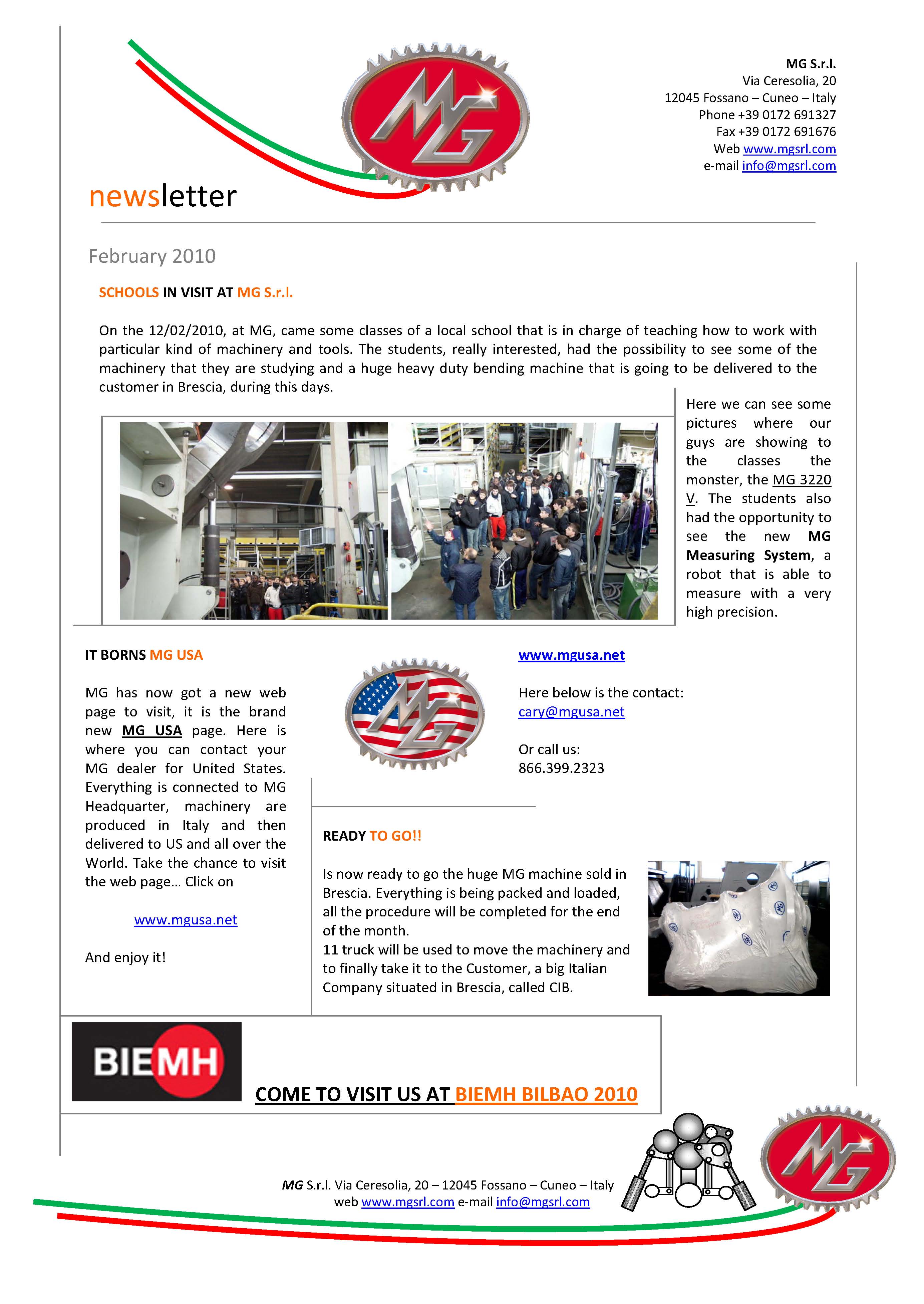
 MG USA is born.
Click here for the full story.
Customer Service Experience
Customized Solutions
C Marshall Fabrication Machinery

MG USA is born.
Click here for the full story.
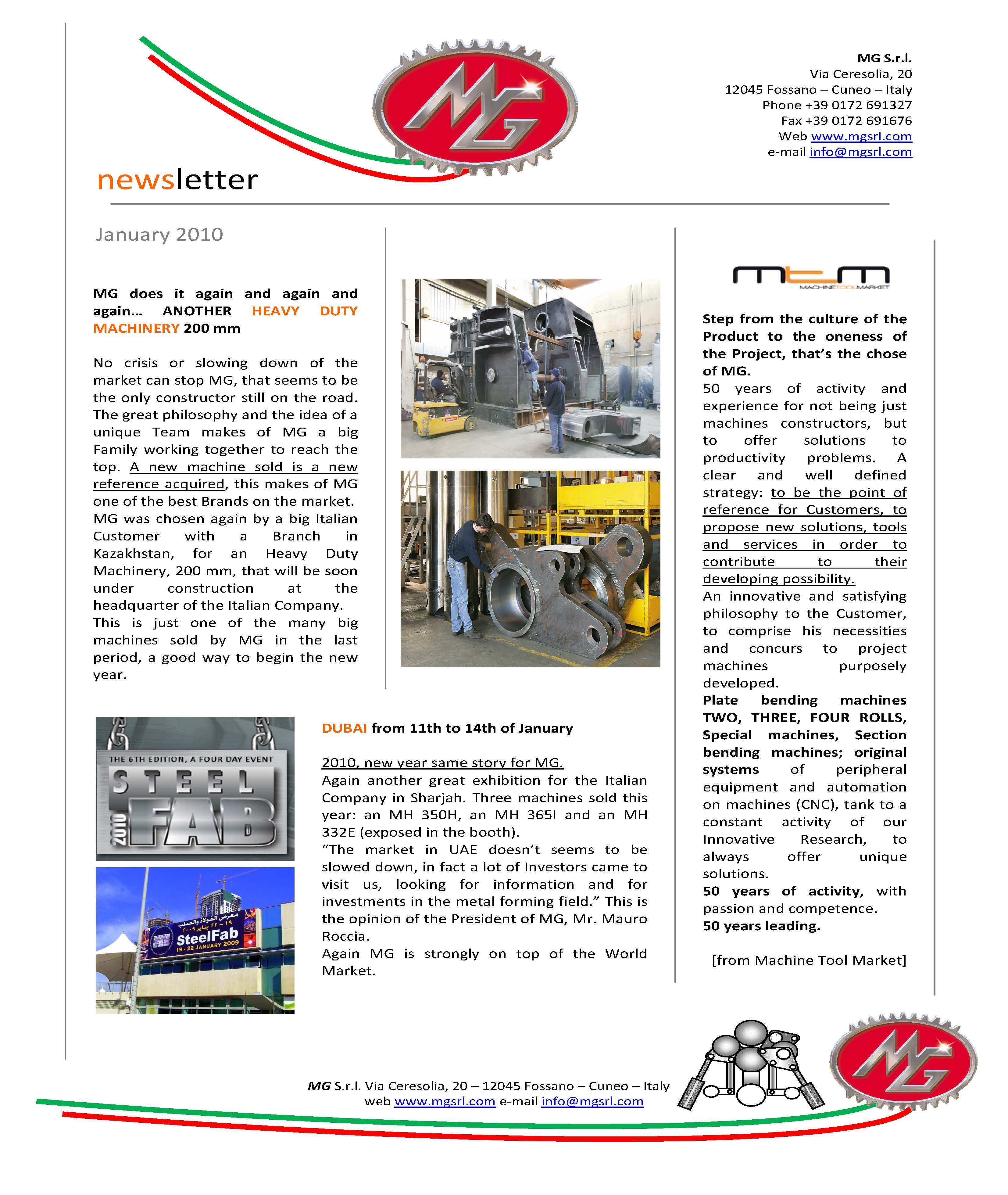 What a great start of a new year! Another heavy-duty machine sold!
Click here for the full story.
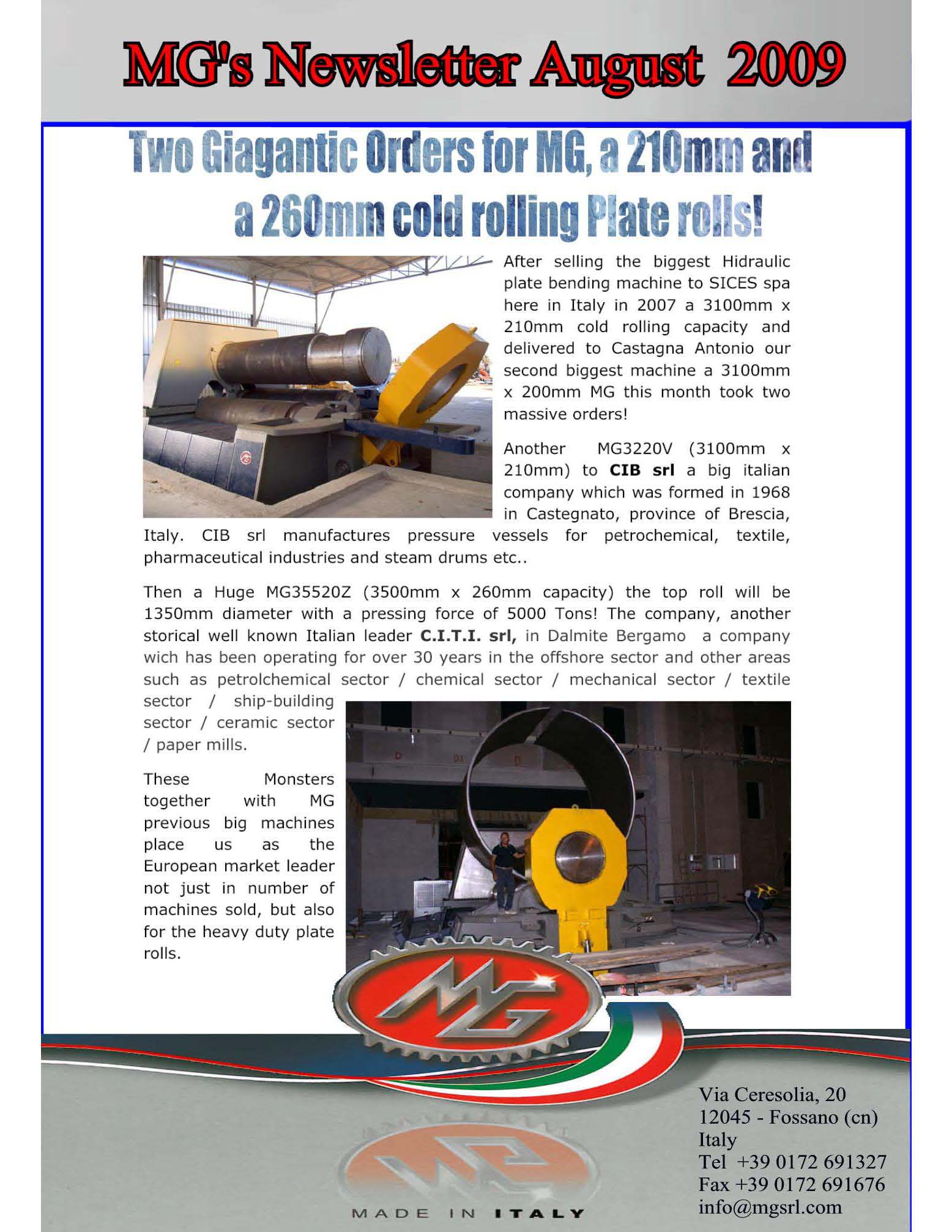 Two gigantic orders for MG; a 210 mm and a 260 mm cold rolling plate rolls!
Click here for the full story.
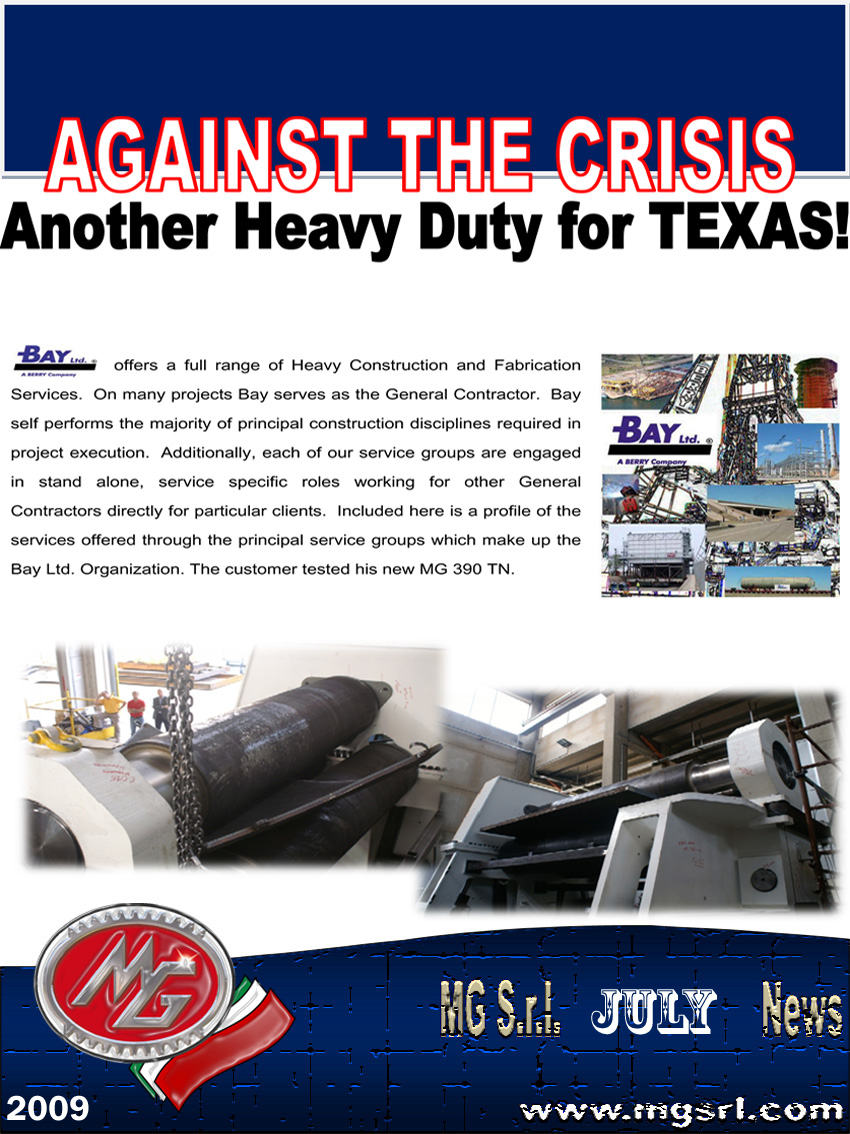 Fighting the crisis! Another heavy-duty sold to Texas, USA.
Click here for the full story.
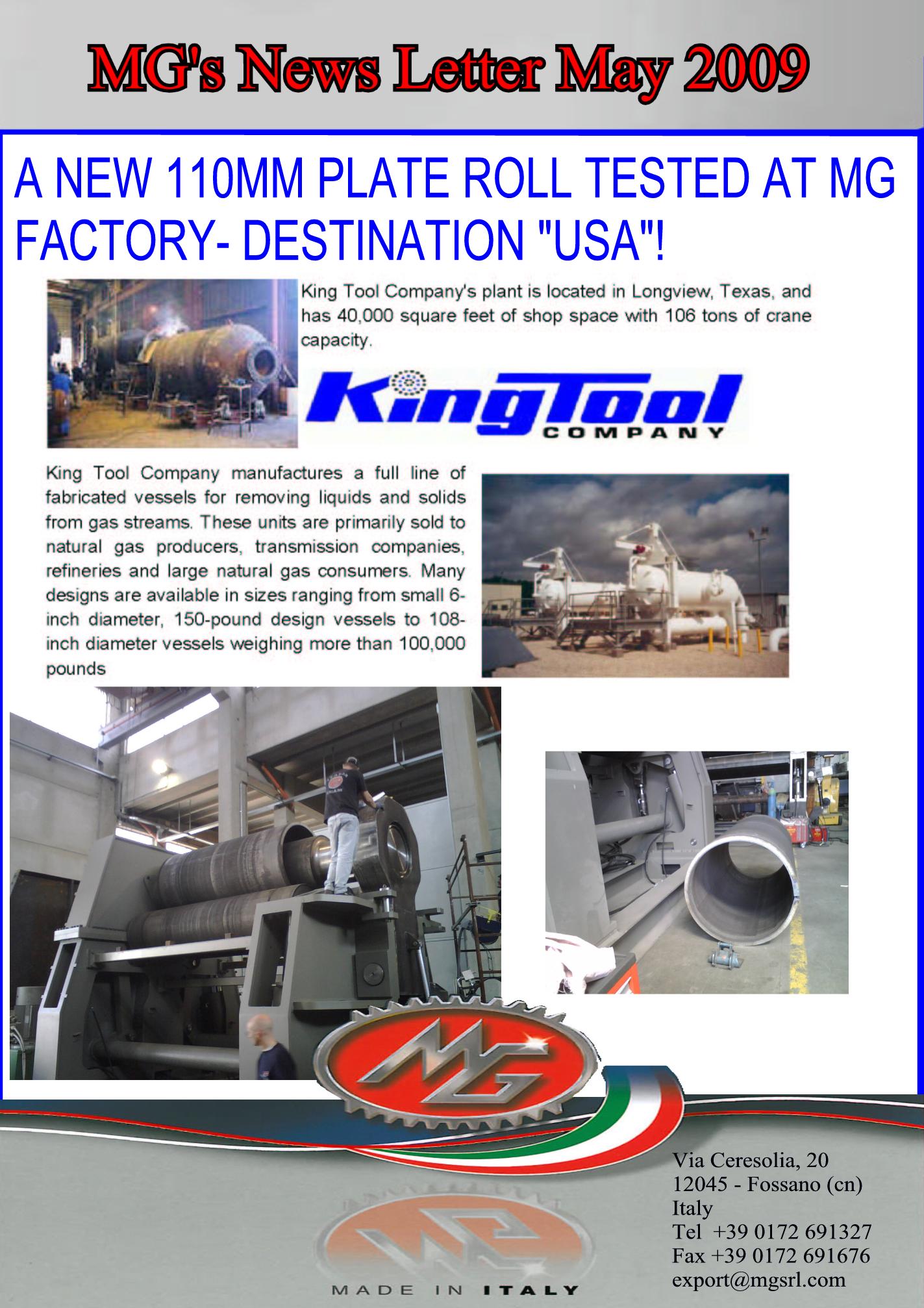 A new 110 mm plate roll tested at MG – destination USA!
Click here for full story.
Its name is MG 32520Z and it is the newly-built Italian “monster”. What do you say about the following:
– 10” bending capacity
– 126” total bending length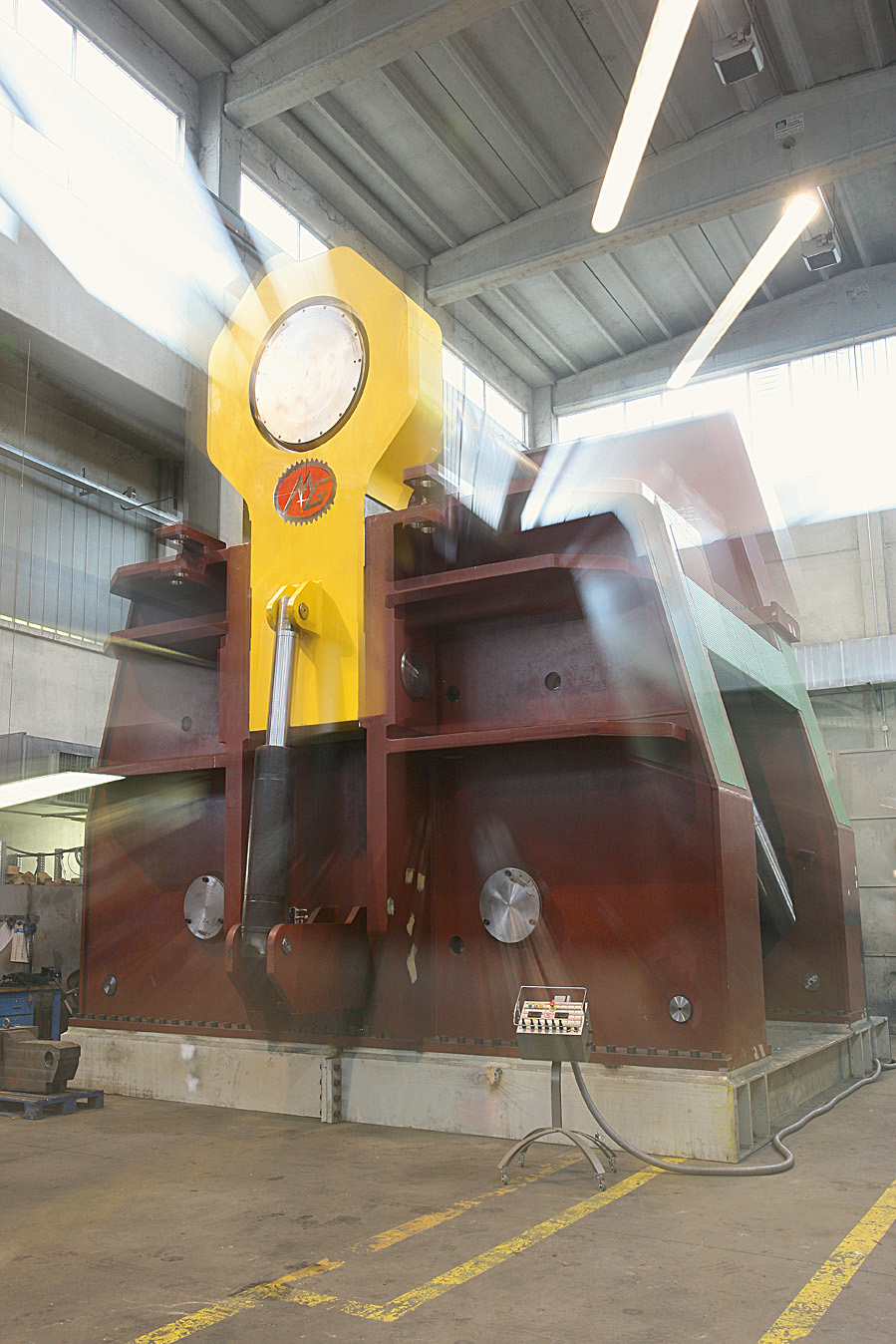
– 55” top roll diameter
– 48” side roll diameter
– 45’ total length of machine
– 25’ total height
– 23’ total width
– 58 tons top roll alone
– 52 tons each side rolls
MG is the largest builder of Plate Rolls in the world. In the last 18 months they have sold four 10′ x 10″ rolls and three 10′ x 8″ rolls as well as 45 “bread and butter” machines each and every month right through this recession!
In the last year we at CMF have sold a 10′ x 4-5/16″ Plate Roll to Longview, TX and a 10′ x 3-3/4″ Plate Roll to Corpus Christ, TX and a several smaller MG 4 Roll Hydraulic Plate Bending Machines across the US.
MG is the #1 seller of rolls in Europe and is now establishing their name here in the U.S.
They have over 300 Plate Rolls in the US and Canada; however, most of the machines were sold by a company that was private labeling them. CMF is now selling them under the official brand name of MG.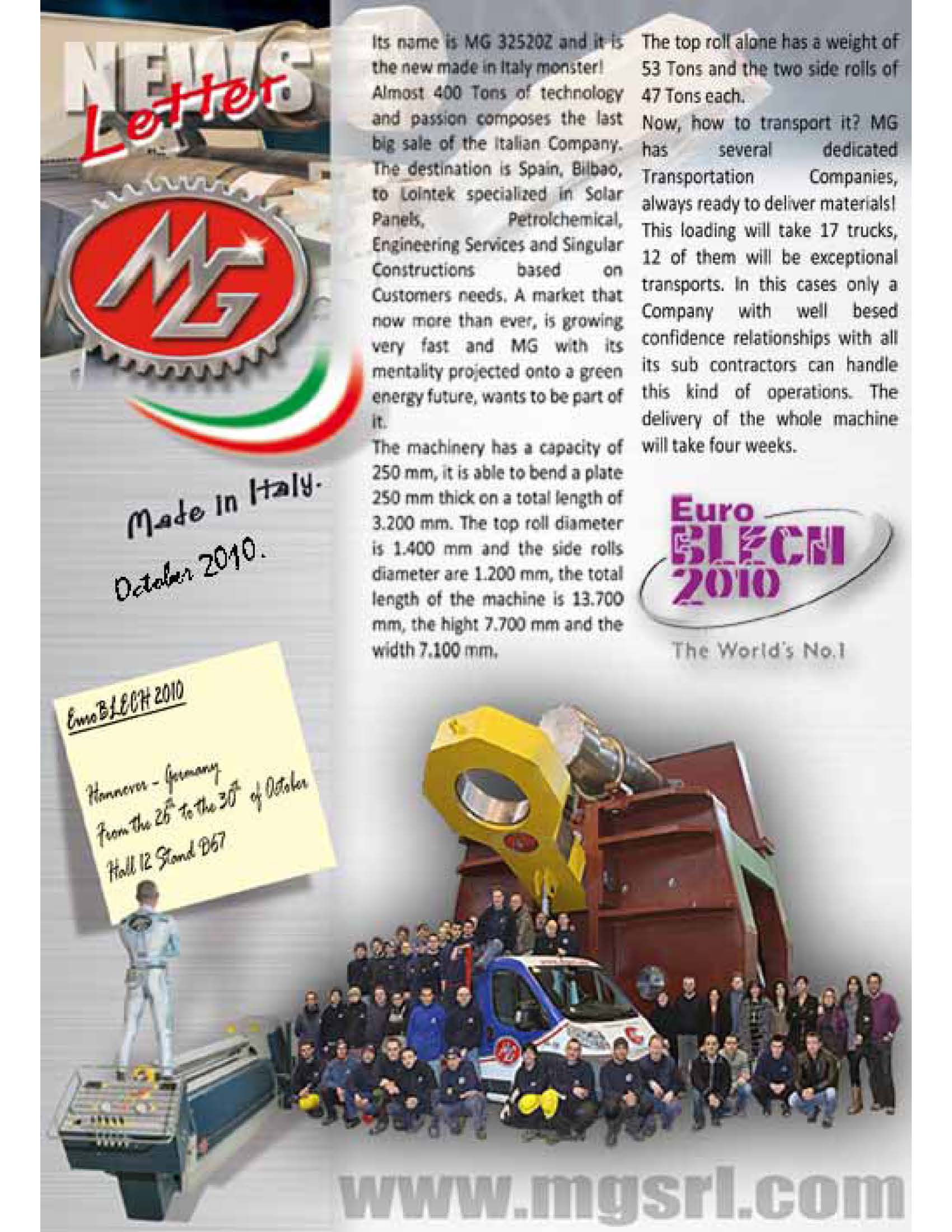
Please click the image to the right to read the full version of the MG October 2010 Newsletter.
Click HERE to see pictures of the machine.
From the desk of Cary Marshall
President
Huh??
In doing a little research in the metal fabrication, machinery, sheet metal, rebar, etc, industry, I came across a tower that, in my opinion, is WAY more interesting that the leaning tower of Pisa.
It is the Leaning Tower of Nevyansk, in Russia.
As opposed to the Pisa tower, which was built in stages as almost an afterthought due to war, the Nevyansk tower was intentional. But what the actual intention was is a mystery.
First and foremost, what brought this tower to my attention is that fact that it is acknowledged as the first known use of rebar in modern concrete construction some 150 years before rebar was “invented”.
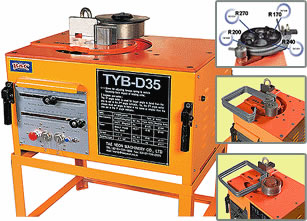 In the metal fabrication machinery business, we are aware that metal fabrication itself predates history. With technology the tools we have available to us have changed as well. The youngest of the line would be rebar benders like our TYB-D35 General Bender.
I say the youngest because, historically speaking, rebar is the youngest. Invented in 1849 by Joseph Monier, reinforced concrete was actually patented by him in 1867. Now considering that metal fabrication as a general subject predates history, 1849 is pretty darn young.
Yet, the Tower of Nevyansk was built somewhere between 1725 and 1732 according to Russian historians. That in itself is noteworthy, but not what really grabbed my attention.
Unlike Pisa, it is believed by some historians that the Nevyansk tower was constructed leaning on purpose. Its face leans toward the builders home town as if paying homage. Of course scientists say that legend is preposterous and that the ground shifted during construction.
I believe that the first is more plausible actually and here is why. The rebar that runs through the entire carcass of the building, internally and externally, runs from the lightening rod on top of the tented roof into the ground. Obvious to me, the rebar was intentional from the beginning.
If the rebar was fabricated and installed after a ground shift, it would be evident as an addition and would only be part of the internal wall reinforcement from the point of discovery up. What do you think? Plausible rebar theory?
Another factor regarding this building that makes it more interesting is that the inner part of the tented roof is the first cast iron dome in history.
If that weren’t enough, the rebar lightening rod is the first in history as well some 25 years before Benjamin Franklin!
But that’s not all. The most interesting thing of all is the buildings purpose, or purposes I should say.
Each floor of the 9 floors housed a specific and even mysterious purpose it seems.
The first, because of the shackles, is considered to be the place of some ‘mysterious work’ performed by enslaved serfs. The second is considered to be an office due to documents found. The third was some kind of laboratory with a furnace. There is a legend that the owner Akinfiy Dimidov smelted coins there due to the silver and gold traces found in soot samples. The fourth, fifth, and sixth floors are simply stairwells while the seventh and eighth floors are dedicated to a clock and bell. The clock itself cost more than the entire construction of the tower.
The ninth floor is an observation tower. But still that is not the end.
Between the fourth and fifth floor there is a small 20 square meter room that is an acoustic marvel. Two people standing in opposite corners of the room can whisper and be heard by each other as if they were standing lips to ear. Intentional construction? Purely accident? Who knows, but it is very interesting.
So here we have a tower that is the first known use of rebar using the latest metal fabrication techniques and machinery known to man in the 18th century that historically holds the trophy for several ‘firsts’ with multiple mysterious purposes that also leans?
Like I said, WAY more interesting than Pisa.
By Michael Graves
I just finished reading an article about the Fabtech Show in Atlanta this November. It calls the show a “Real Show-Stopper” and even if I still have weeks to go, maybe months, before the leads I collected from this show will start either generating business or turning out to be “bad leads” I have to agree that the Atlanta show was in many ways much better than the one in Chicago last year.
One reason for Fabtech Atlan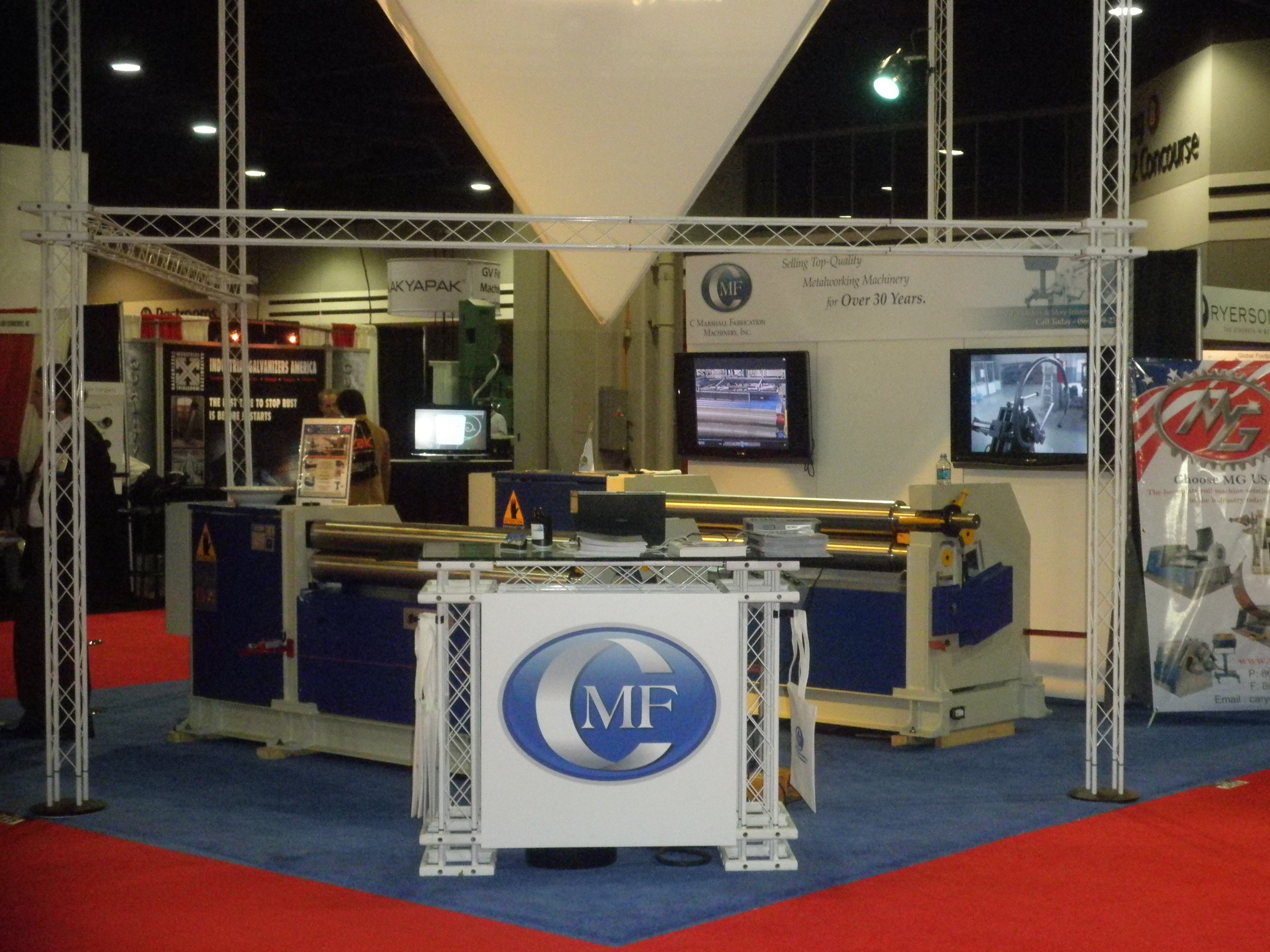 ta being a good show was of course that it attracted more exhibitors as well as visitors than the Chicago one but it was not just that; it was the overall feeling of everyone being happier with the quality of leads, the buzz around the exhibit booths and the feeling of maybe “the worst being behind us” – all in all most everyone had a brighter outlook on the future and hopes on that the busy Fabtech 2010 was just another indication on that the manufacturing business is on a path of recovery.
CMF took a bold approach at this year’s exhibit and showed up in a new, professionally designed booth in a great location attracting visitors to stop by, ask questions and request call backs and information on the two asymmetrical plate bending machines (CYL-ST 170-15/5 and CYL-ST 170-15/7) on the floor and others (plate rolls, shears, brakes, ironworkers and rebar benders and cutters) offered by CMF.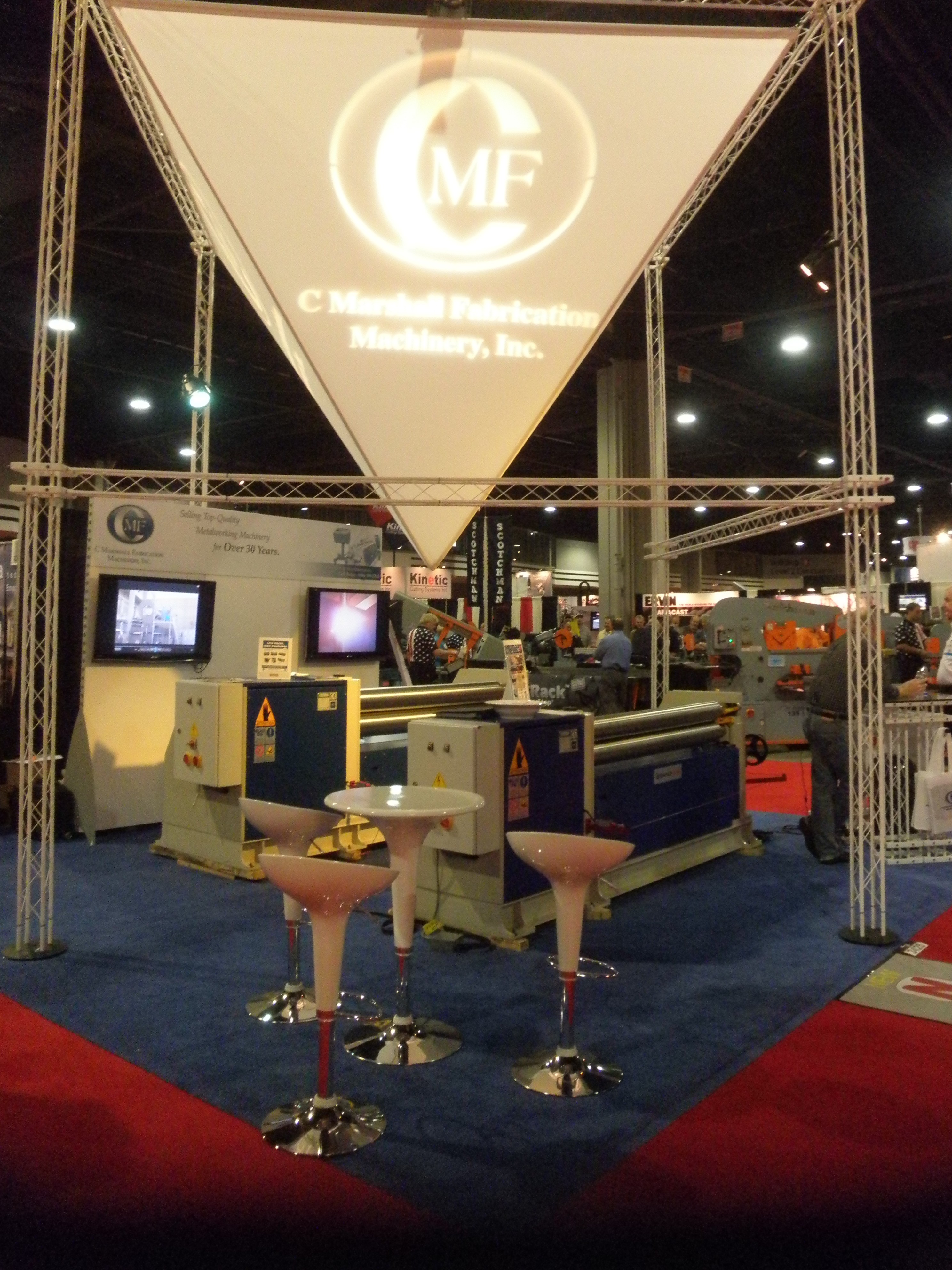
The show is now over but is still a very active part of my work today; however, I am already looking into all the planning that is going to start shortly in order to be ready for the next year’s show in Chicago, IL on November 13-16.
Much work still remains to be done before I can actually confirm whether the show really was as good as I felt it was. It will be busy times until the end of this year and hopefully even busier starting the new 2011.
As the Holiday Season is approaching I wish my customers, vendors, dealers and all the people active in the metal fabrication world a Very Happy Thanksgiving.
Cary Marshall
President
Please click HERE for additional pictures from the show.
“Back when I was your age…” is a phrase that is practically a cliché today. But it fits here.
In today’s age of advanced metal fabrication we take for granted the tools and machines that we have at our disposal. If our fabrication peers of the past, say the 20’s and 30’s 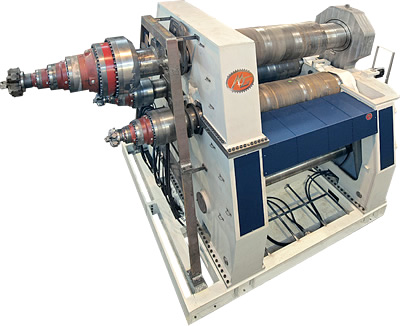 could somehow see our MG Angle Roll, Plate Roll, and Press Brakes, they would probably look upon them with awe and envy.
Or would they?
Although the machinists, metal fabricators, and construction foreman of the past would look upon our machines today as nothing short of a miracle, they could pull off miracles of their own.
Take for example the race for the tallest building of 1929 between Walter Chrysler and H. Craig Severance.
In 1929 both men were racing to complete the tallest building in the world at the time. Severance was so convinced that he and his colleagues had won the race with their 40 Wall Street monster, aka the Bank of Manhattan, aka Trump Tower, that before the interior was even finished he held a major downtown elite ceremony claiming the prize. Originally 808 feet, Severance added a 60 foot steel cap to reach 925 feet and then celebrated with the crème de la crème.
“The World’s Tallest Building Raises the Stars and Stripes to the New York heavens!” read the headlines.
Unfortunately their record held for a short two weeks.
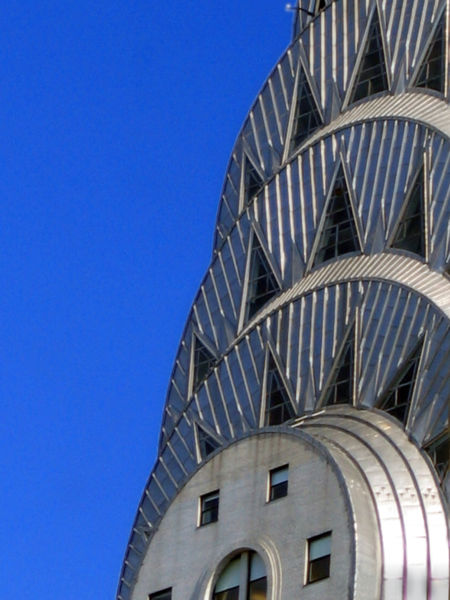
Unbeknownst to Severance, within the walls of Chryslers neighboring building, 27 ton, 186 foot steel sheet metal masterpiece called “The Spire”. It was comprise of 4 sections that were clandestinely constructed within the walls of the unfinished building. And on October 23, 1929 the first piece was lowered in place. Afterward, the remaining pieces were hoisted and riveted into place.
Besides the constructing the spire with the best metal fabrication machinery available at the time right under Severance’s nose without his knowledge, what else makes this a miracle? The entire process of installing the 186 foot 27 ton sheet metal sculpture on top of the 66th floor of the Chrysler Building only took an amazing 90 minutes to complete.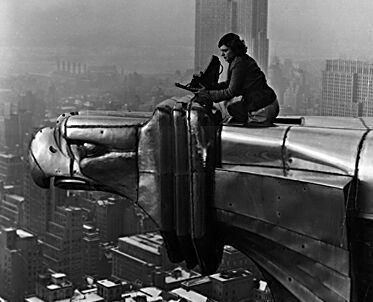
Nope. It’s not a typo. 90 minutes. As in 1 and ½ hours.
So, although we here at C. Marshall Fabrication Machinery, Inc. have the machines that would seem like marvels of science fiction to grandpa and his fellow workers, there is credence to his words when he says “Back when I was your age…”