Month: October 2012

Unemployment Rate Drops In 41 States.

The CBS Evening News (10/19, story 5, 0:30, Pelley) reported, “We got a good jobs report today. A Labor Department report shows unemployment fell last month in 41 states, including most of swing states that may decide this election. In Nevada, unemployment has fallen from 13.6% a year ago to 11.8%. It’s still the highest in the nation. In Ohio it’s down from 8.6% to seven, and in Florida unemployment fell from 10.4% to 8.7%.”

The AP (10/19, Rugaber, Pace) reported unemployment “fell last month in nearly all of the battleground states that will determine the presidential winner,” giving President Obama “fresh fodder to argue that voters should stick with him in an election focused squarely on the economy.”

The Wall Street Journal (10/20, Mitchell) reported jobs were added in most of the 41 states where the unemployment rate declined.

The Washington Post (10/20) and Los Angeles Times (10/20, Lifsher, Flores) also covered the story.

From Daily Executive Briefing 10/22/2012

Manufacturing in Philadelphia Area Grows More Than Forecast

Manufacturing in the Philadelphia region expanded in October for the first time in six months, a sign the industry may be starting to stabilize.

The Federal Reserve Bank of Philadelphia’s general economic index rose to 5.7 from minus 1.9 in September, a report today showed. A reading of zero is the dividing line between expansion and contraction. The median forecast of 61 economists surveyed by Bloomberg was for an increase to 1.

he report, contrasting with data showing New York-area factories shrank for the third straight month, indicates that a pillar of the recovery is starting to regain its footing. Gains in confidence and household wealth mean consumer spendingmay help cushion manufacturing at a time when business investment and exports are hurt by slowing global growth and uncertainty about U.S. tax changes.

“Manufacturing has troughed in terms of the declines in activity,” Russell Price, senior economist at Ameriprise Financial Inc. in Detroit, said before the report. “As the recession in Europe becomes less severe, it will take the pressure off exports. There is some demand” in the U.S.

The Philadelphia Fed’s report covers eastern Pennsylvania, southern New Jersey and Delaware. Estimates in the Bloomberg survey ranged from minus 2.7 to 5.8.

Jobless Claims

Other reports today showed more Americans than forecast filed applications for unemployment benefits last week,consumer confidence rose to a six-month high and the index of leading indicators climbed more than forecast in September.

Jobless claims increased by 46,000 to 388,000 in the week ended Oct. 13, reflecting an unwinding of adjustments for seasonal swings at the start of a quarter, from a revised 342,000 the prior period that was the lowest since February 2008, according to Labor Department data.

The Bloomberg Consumer Comfort Index rose to minus 34.8 in the week ended Oct. 14, the highest level since April, from minus 38.5 the previous week. The monthly expectationsgauge improved to minus 7 in October, the best reading since May.

The Conference Board’s gauge of the outlook for the next three to six months increased 0.6 percent last month after a revised 0.4 percent drop in August that was bigger than initially reported, the New York-based group said. Economists projected the gauge would climb 0.2 percent, according to the median estimate in a Bloomberg survey.

Component Breakdown

The Philadelphia Fed’s overall index isn’t composed of the individual measures, one reason some economists consider it a gauge of sentiment among manufacturers. Manufacturing makes up about 12 percent of the U.S. economy.

The breakdown of today’s Philadelphia Fed data was less encouraging than the headline reading. The employment index decreased to minus 10.7, the lowest reading since September 2009, from minus 7.3. The new orders measure dropped to minus 0.6, the fifth contraction in the past six months, from a reading of 1 in September.

The shipments gauge climbed to minus 0.2 from minus 21.2. Its inventory index rose to 2.1 from minus 21.7.

The index of prices paid rose to 19 from 8, while a gauge of prices received increased to 5.4 from minus 0.2.

Factory managers in the region also become less optimistic about the future. The gauge of the outlook for six months from now dropped to 21.6 this month from 41.2 in September.

Figures from the New York Fed on Oct. 15 showed the so- called Empire State index rose to minus 6.2 this month from September’s minus 10.4 reading.

Less Optimistic

Economists monitor the New York and Philadelphia Fed factory reports for clues about the Institute for Supply Management national figures on manufacturing. The ISM report is due on Nov. 1.

The automobile industry remains a source of growth. Cars and light trucks sold at a 14.9 million annual pace in September, the most since March 2008, according to data from Ward’s Automotive Group. Chrysler Group LLC and General Motors Co. (GM) reported gains.

Businesses restrained by weakening overseas growth include Alcoa Inc. (AA), the largest U.S. aluminum producer. The New York- based company cut its forecast for global consumption of the metal on slowing Chinese demand.

“We do see a slight slowdown in some regions in end- markets, and the main driver for this isChina,” Chairman and Chief Executive Officer Klaus Kleinfeld said on a conference call with analysts this month.

Manufacturing also is stabilizing at the national level, a report showed this week. Industrial production, or output at factories, mines and utilities, rose 0.4 percent in September after a 1.4 percent drop in August that was the biggest since March 2009, according to Fed data issued Oct. 16.

To contact the reporter on this story: Shobhana Chandra in Washington at schandra1@bloomberg.net

To contact the editor responsible for this story: Christopher Wellisz at cwellisz@bloomberg.net

Unemployment rate falls to 7.8% in September


The nation’s jobless rate dropped to its lowest point in nearly four years in September. And unlike some recent declines, this one happened for the right reason: not because people gave up looking for a job, but because far more people reported having one.

It is a surprising improvement in a job market that had appeared listless in recent months. Although employers added a modest 114,000 jobs in September, the unemployment rate dropped sharply, from 8.1 to 7.8 percent, the government reported Friday.

Unemployment is at its lowest level since President Obama took office in January 2009, offering him a political boost just days after his performance was widely judged as lackluster during a debate against GOP rival Mitt Romney.

The government said hourly wages were up and employees worked more hours in September, meaning they were taking home bigger checks. Overall, the ratio of the American population with a job reached its highest level since May 2010.

The drop in the unemployment rate was bolstered by revisions reflecting that employers had added 86,000 more jobs than previously known in July and August, recasting the troubling summer lull in job creation to a season of solid employment gains.

Although the report offered a brightening picture of the nation’s labor market, the overall rate of job creation remains less than robust. In addition, unemployment remains far above normal levels, and many millions who have jobs are not working full time.

“While the September employment report was more encouraging than the ones we have seen in recent months, the job market is still a long way from rosy, good health,” said Gary Burtless, a Brookings Institution economist.

This year, employers have added only slightly more jobs per month than are needed to keep pace with normal labor-force expansion, and slightly fewer than the 153,000 average monthly gain the nation experienced in 2011. Also, the number of Americans working part-time — even though they want full-time jobs — rose sharply last month to 8.6 million.

With economic growth creeping along after showing signs of more vigorous expansion last year, some economists were skeptical of the magnitude of September’s unemployment decline. A few even predicted that the jobless rate would tick up in the coming months.

“This was a pretty good report, but the drop in the unemployment rate was just too good to be true and probably overstates the degree of improvement in the job market,” said Stuart G. Hoffman, chief economist for PNC Financial Services Group.

Even at 7.8 percent, the joblessness rate remains high by any historical standard. And it could be years before the economy returns to full employment.

But Bernard Baumohl, chief global economist for the Economic Outlook Group, said the dichotomy between the recent steep decline in the jobless rate and the slow economic growth in recent months could mean that the economy is poised to take off.

Economic “growth may turn out to be stronger than most economists currently forecast,” he said. “ . . . Employers are, thus, cautiously turning more optimistic about the economy in 2013 and becoming less apprehensive about hiring.”

Source: Washington Post (10/6, Irwin, Henderson) 

Manufacturing in U.S. Expands Unexpectedly as Orders Rise

Manufacturing unexpectedly expanded in September after three months of contraction, reflecting stronger orders that ease concern the U.S. economy will slow further.
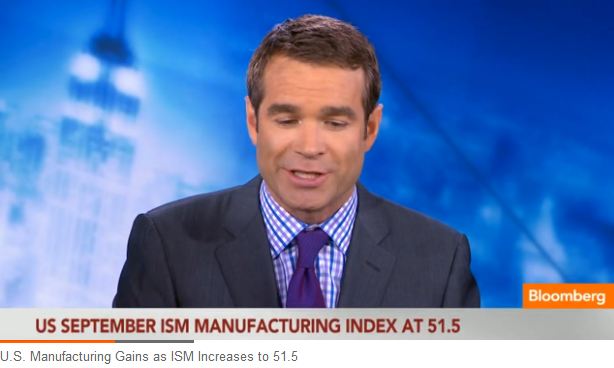
Click image above: Oct. 1 (Bloomberg) — Bloomberg’s Erik Schatzker reports that the Institute for Supply Management’s U.S. factory index rose to 51.5 in September from 49.6 a month earlier. The dividing line between expansion and contraction is 50. He speaks on Bloomberg Television’s “Market Makers.”

The Institute for Supply Management’s factory index rose to 51.5 last month from 49.6 in August, the Tempe, Arizona-based group said today. Readings above 50 show expansion, and the September measure exceeded the most optimistic forecast in a Bloomberg survey.

Stocks extended gains after the figures showed American factories are holding up in contrast to their counterparts inEurope and Asia. Sustained strength in motor vehicle sales and a rebound in demand for home construction materials are helping cushion manufacturers from weaker exports and cutbacks in business investment.

“Housing is definitely supporting,” said Michael Feroli, chief U.S. economist at JPMorgan Chase & Co. in New York. “The economy still seems to be expanding, even if modestly, and that should keep overall manufacturing growing.” Still, “it’s hard to see things materially accelerating from here.”

The median forecast in the Bloomberg survey was 49.7, andestimates from the 76 economists surveyed ranged from 48 to 51.2. A reading above 42.6 generally indicates an expansion in the overall economy, the ISM said. The gauge averaged 55.2 in 2011 and 57.3 a year earlier.

Construction Spending

Homebuilding outlays climbed 0.9 percent in August, a report from the Commerce Department showed today. A drop in non- residential projects pushed down overall construction spendingby 0.6 percent, the most since July 2011.

Federal Reserve Chairman Ben S. Bernanke today renewed a pledge to sustain record stimulus even after the U.S. expansion gains strength, while saying policy makers don’t expect the economy to remain weak through 2015.

“We expect that a highly accommodative stance of monetary policy will remain appropriate for a considerable time after the economy strengthens,” Bernanke said in a speech in Indianapolis. Policy makers’ forecast to hold the main interest rate near zero until at least mid-2015 “doesn’t mean that we expect the economy to be weak through” that year.

The Standard & Poor’s 500 Index climbed 0.3 percent to 1,444.49 at the close in New York. Treasuries were little changed with the yield on the benchmark 10-year note at 1.62 percent compared to 1.63 late on Sept. 28.

Orders, Employment

The ISM’s new orders measure rose to a four-month high of 52.3 from 47.1. The employment index advanced to 54.7 from an almost three-year low of 51.6 the prior month. The gain from August was the biggest since October 2009. The group’s measures of production, export demand, prices paid and order backlogs also climbed in September.

A pickup in new-home construction and stronger auto sales are sources of strength for manufacturing. Housing starts increased in August, reflecting the strongest pace of single- family projects in more than two years, Commerce Department figures showed Sept. 19.

Autos in August sold at a 14.46 million annual rate, the fastest since the surge in August 2009 tied to the government’s “cash-for-clunkers” program. They were up from a 14.05 million pace in July, according to data from Ward’s Automotive Group.

The ISM figures compare with others showing weakness worldwide. In the euro-area, manufacturing contracted for a 14th month in September, suggesting the economy may have struggled to avoid a recession in the third quarter. A gauge of the industry in the 17-nation currency region based on a survey of purchasing managers was 46.1, Markit Economics said today. The index has held for 14 months below 50, indicating contraction, and fell as low as 44 in July.

U.K. Manufacturing

U.K. factories shrank more than economists forecast and export orders declined for a sixth month. A measure based on a survey of purchasing managers fell to 48.4 from 49.6 in August, Markit Economics and the Chartered Institute of Purchasing and Supply said in London today.

In China, manufacturing contracted for an 11th straight month, increasing pressure on the government to bolster growth in the world’s second-largest economy. The purchasing managers’ index from HSBC Holdings Plc and Markit Economics was at 47.9 last month, compared with 47.6 in August. Export orders declined at the fastest pace in 42 months and factory purchasing activity fell for a fifth consecutive month, the Sept. 29 report showed.

‘Surprisingly Good’

“Manufacturing in the U.S. looks surprisingly good against a backdrop of weak performance in China and the euro area and the looming fiscal cliff,” said Dirk Chlench, head of bond research at Landesbank Baden-Wuerttemberg in Stuttgart, Germany, who had the highest ISM projection, 51.2, in the Bloomberg survey.

Still, some companies, like steel-processor Worthington Industries Inc. (WOR), are tempering their outlook.

“We don’t have a great deal of clarity on where the economy is going,” John McConnell, the Columbus, Ohio-based company’s chairman and chief executive officer, said on a Sept. 27 earnings call. “We’re also not saying that everything’s horrible out there. We’re saying we have some reason to be cautious.”

Caterpillar Inc. (CAT), the world’s biggest construction and mining equipment maker, last week cut its forecast for 2015 earnings after commodity producers reduced capital expenditures. While a global recession remains possible, Caterpillar is forecasting moderate and “anemic” growth through 2015, Chairman and Chief Executive Officer Doug Oberhelman said in a presentation to analysts on Sept. 24.

Europe’s Economy

“We are in no way thinking we’re going to see a recession in 2013,” Oberhelman said. “Europe’s in recession today, probably going be a while to dig out.”

To boost growth and stimulate more hiring that may provide a spark for the economy, the Fed last month said it would keep its target interest rate close to zero until at least mid-2015 and began a third round of stimulus, buying $40 billion in mortgage bonds a month.

“If the outlook for the labor market does not improve substantially, the committee will continue its purchases of agency mortgage-backed securities, undertake additional asset purchases and employ its other policy tools as appropriate,” the Federal Open Market Committee said Sept. 13 in a statement at the end of a two-day meeting in Washington.

To contact the reporter on this story: Michelle Jamrisko in Washington atmjamrisko@bloomberg.net

To contact the editor responsible for this story: Christopher Wellisz at cwellisz@bloomberg.net