Month: July 2011

Leading the News

FRB Dallas: Texas Factory Activity Rebounded In July.

The Dallas Morning News (7/26) reports, “Texas factory activity rebounded in July as the manufacturing sector gained strength, data from the Federal Reserve Bank of Dallas showed Monday.” The Dallas Fed said the production index “rose from 5.6 in June to 10.8 this month. The Fed’s Manufacturing Outlook Survey also found growing activity in other measures of current manufacturing conditions: The shipments and new orders indexes rose from June to July. The shipments index rose to 7.8 after coming in at zero last month. The new orders index rose sharply from 6.4 in June to 16 in July.”

In an article on job increases in Texas, USA Today (7/26, Davidson) notes that one of “reasons for the state’s robust job growth” is an increase in exports. “Overseas shipments by Texas’ strong computer, electronics, petrochemical and other industries rose 21% last year, compared with 15% for the nation, according to the Dallas Federal Reserve Bank. The state also benefits from its proximity to Latin American countries that are big importers of US goods,” according to Moody’s economist Ed Friedman. “The surge creates jobs for Texas manufacturers and ports.”

Portland, Oregon Adds Manufacturing Jobs In June. The Portland Business Journal (7/25, Giegerich) reported, “The Portland-area’s June unemployment rate was unchanged month-to-month but decidedly lower than it was a year ago.” However, “the manufacturing sector added 1,400 jobs” last month. “Some 900 of those were in the durable goods category. Since the beginning of the year, the manufacturing sector has added 2,600 jobs, a 2.4 percent increase over 2010.”

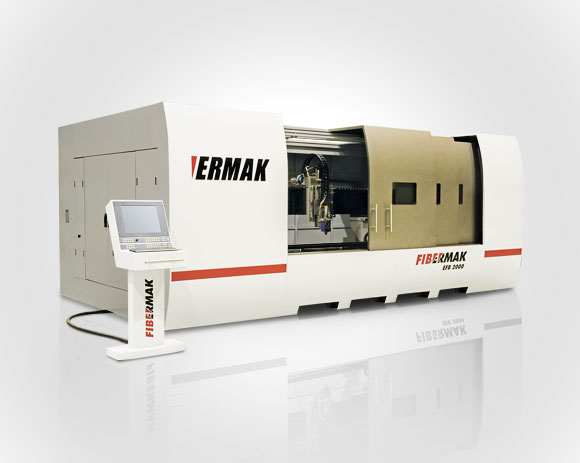
FIBERMAK Fiber Optic Laser Cutting Machine sold in USA!

Congratulations to Mac-tech!

Mac-tech sold the first Ermak fiber laser in North America. The machine is a 6 x 12 3kW Fibermak and possibly the largest table size ever sold in North America.

FIBERMAK is a peerless machine in laser technology with its strong designs, ultra low energy sonsumption, fast cutting capacity and almost zero maintenance cost.

FIBERMAK transmits the laser beam onto the sheet metal by fiber cables and its cutting quality with high beam density is perfect on thin sheets compared on other alternatives. Fiber optic laser cutting technology proves high quality cuttings at very fast speeds. the energy consumption is %70 less compared to Co2 lasers. You’ll also benefit from easy cutting of reflecting materials as aluminium, copper, brass etc. via low wavelength depending to its working principle.

  • 60% – 100% faster compared to other laser cutting machines.
  • Axes equipped with Bosch – Rexroth liear motors and drivers reach to 9.8’/min (120 m/min.) speed and accelerations are 2 G on Y, 1,5 G on X axes
  • Cuts thin materials 3 times faster compared to Co2 lasers and energy consumption is simultaneously lower
  • 70% energy savings by fiber optic laser technology
  • No need to laser-mix gas used Co2 laser cutting machines due to diode technology
  • No need to optical components such as beam path, folding mirror and quartz tube etc. as laser transmitting is done by fiber cable
  • You can make production 24 hours a day and may save 50% per each costs
  • You may reflect materials such as aluminyum, copper, brass etc. precisely and by smooth surface quality
  • FIBERMAK has strong frame, equipped with worldwide well known, long life, quality components and designed to work accurately and continuously even at hard conditions.

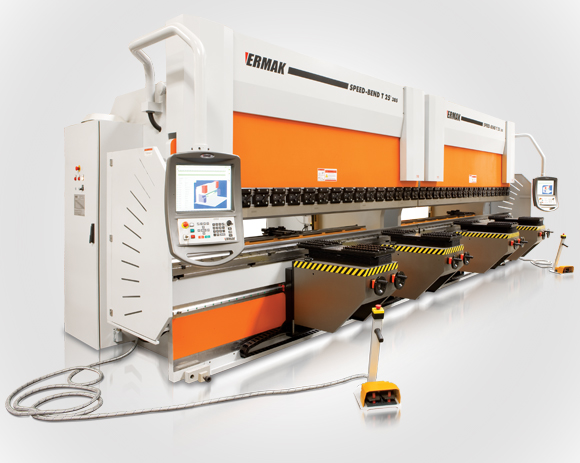
Speed-Bend Tandem Press Brake Sold in USA!

Speed-Bend Tandem Press Brake

Congratulations to Watson Hegner!

A Speed-Bend tandem press brake – 48,5′ x 2200 ton  – was sold to Ryerson steel by Watson Hegner last week.

This is the largest tandem press brake sold in North America of Ermak line and will be a jewl in the crown.

Tandem press brakes consists of at least two machines which are able to bend sheet and plate materials that are up to 105′ (32 meters) on a single operation. These press brakes also have a feature of working together as well as working alone. Each machine is equipped with separate hydraulic, electrical and electronic equipments. All the equipments used as standard and optional accessories are chosen particularly from the latest technology using companies whose products are accepted worldwide. Squiring the high performance with high efficiency by the user is our basic principle.

  • User friendly and reliable working environment providing complex Hydraulic system which you can use free of problems for years.
  • Bending tools at various dimensions and special types.
  • High precision bending opportunity with adjustable tonnage, back gauge and stroke adjustment according to tooling and sheet metal specs.

MG July 2011 Newsletter

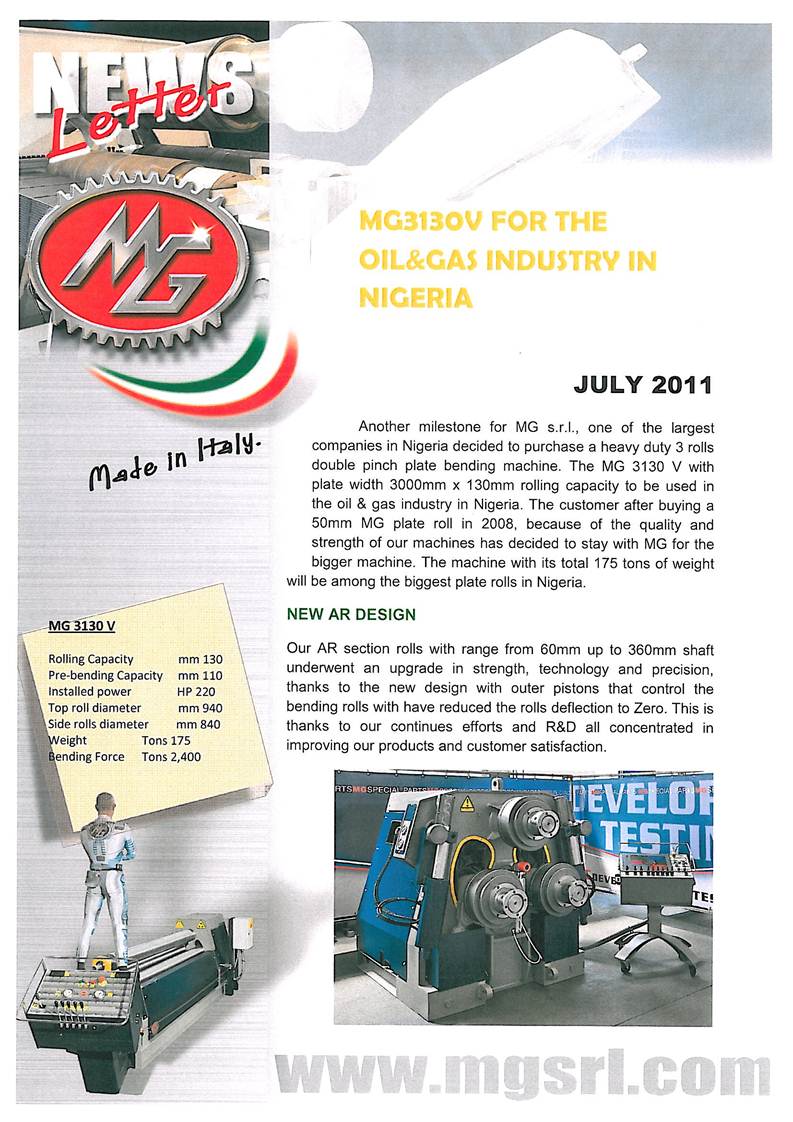
MG3130V for the Oil & Gas Industry in Nigeria

Another milestone for MG s.r.l. as one of the largest companies in Nigeria decided to purchase a heavy duty 3 rolls double pinch plate bending machine. The MG 3130 V with plate width of 10′  x 5-5/16″ rolling capacity is to be used in the oil & gas industry in Nigeria.

  • Rolling capacity: 5-5/16″
  • Pre-bending capacity: 4-5/16″
  • Installed power: 220 HP
  • Top roll diameter: 39″
  • Side rolls diameter: 33.1″
  • Weight: 175 tons
  • Bending force: 2400 tons

Please click HERE for the full Newsletter.

Leading the News

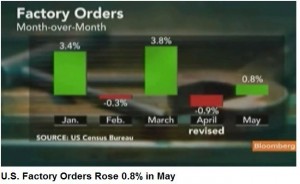
US Factory Orders Rose In May.

Click image to left for video.

Bloomberg News (7/6, Kowalski) reports, “Orders placed with US factories increased in May, indicating manufacturing may rebound from a slowdown in economic growth in the first half of 2011.” The Commerce Department found that “bookings for manufacturers’ goods rose 0.8 percent, less than forecast, after a revised 0.9 percent decline in April that was smaller than previously estimated.” Durable goods demand was up 2.1 percent. According to Bloomberg, “the improvement in orders supports the view of Federal Reserve officials, who last month said the economic slackening likely reflects temporary restraints.”

The AP (7/6, Rugaber) reports that “the jump in factory orders after a sluggish spring suggests supply disruptions stemming from the Japan crisis are fading.” Factory orders reached $445.3 billion overall, which is “almost 32 percent higher than the low point during the recession, reached in March 2009.” The AP notes that “much of the increase was driven by a 36.5 percent increase in orders for aircraft, a volatile category.” However, “there were also signs of strength in areas that had slowed sharply in the previous month,” such as internal company investment.

Reuters (7/6, Mutikani) reports that while durable goods orders were up, inventories for manufactured nondurable goods were somewhat weaker. According to the Wall Street Journal (7/6, Bater, Ackerman, Subscription Publication) the gains were slightly disappointing to economists, who on average had expected a full percentage-point increase in factory orders.

The Hill (7/6, Schroeder) reports in its “On The Money” blog, “The 60 experts surveyed by Bloomberg anticipated new orders would rise on average 1 percent, but there was substantial variance in those projections, ranging from a 0.3 percent decline to a 2.1 percent boost.”

Under the headline “US Factory Orders Lift Recovery Hopes,” the Financial Times (7/5, Kassel, Subscription Publication) reports a more positive take on the news, quoting experts who see strong indications for second-half growth, although they add that the scale of that growth could be modest.

From SME Daily Executive Briefing 7.6.2011

Manufacturers Upbeat About Second Half

Appropriate for Independence Day, the U.S. manufacturing sector closed the first half of 2011 with a bang.

At least that’s what the data concluded.

In the days leading up to the Fourth of July weekend, we saw positive manufacturing numbers issued by the national Institute of Supply Management and ISM Chicago, as well as by the Federal Reserve banks of Dallas, Kansas City and Richmond.

“I think they all really show that there’s been a little bit of a rebound in manufacturing,” Chad Moutray, chief economist for the National Association of Manufacturers, tells IndustryWeek.

Include the U.S. Census Bureau’s May data on durable-goods orders (released June 24), and Moutray believes “that clearly we have started to turn around.”

The capstone of an upbeat week came Friday, when the national ISM reported that its June purchasing managers index climbed 1.8% to 55.3.

On June 27, the Federal Reserve Bank of Dallas’s latest Texas Manufacturing Outlook Survey indicated that factory activity picked up in June.

The Federal Reserve Bank of Kansas City’s June Manufacturing Survey, issued June 30, showed that manufacturing in Kansas, Oklahoma and other Plains states “rebounded solidly after a brief slowdown” in May.

“Producers remained generally optimistic about future activity,” Chad Wilkerson, vice president and economist for the reserve bank, said in a news release.

Karen Kurek believes that the recent manufacturing numbers show that the slowdown earlier in the year was merely a symptom of the supply chain disruptions caused by the crisis in Japan.

“I think this is really good news,” says Kurek, who is the national manufacturing practice leader for the business consulting firm McGladrey.

A More Fundamental Slowdown Underway

Cliff Waldman, economist for the Manufacturers Alliance/MAPI, is far less sanguine about the recent manufacturing data.

Waldman asserts that ISM’s June purchasing managers index “provides further evidence that U.S. manufacturing growth is slowing amidst a struggling U.S. expansion and clear signs of moderation in the global economy.”

“The overall index rebounded only modestly from a sharp fall in May, indicating that while the supply chain disruptions from the Japanese disaster have impacted manufacturing growth in recent months, a more fundamental slowdown is underway,” Waldman says.

Waldman is particularly disheartened by the backlog of orders index — one of 11 indices in ISM’s monthly manufacturing report — which slipped from 50.5 in May to 49.0 in June.

Waldman asserts that the drop points to “what will likely be moderate factory-sector activity in the months ahead.”

Indeed, there’s plenty of reason for manufacturers to be cautiously optimistic — emphasis on “cautiously.”

The biggest reason is the specter of rising commodity prices.

In McGladrey’s spring survey of manufacturing executives, 90% of respondents said they expected their raw-materials costs to go up, Kurek notes.

With consumer confidence still wobbly, manufacturers are grappling with the difficult decision of whether or not to pass those price increases onto their customers, Kurek says.

Durable-Goods Sector Getting Stronger

Manufacturers, Moutray agrees, will be keeping a close eye on commodity and energy prices, “and inflation in general.”

They’ll also be watching what happens in Washington, D.C. — where the debt crisis has taken center stage — “with a little bit of wonder.”

Still, Moutray is encouraged by what he’s seeing, particularly in the comeback of the auto industry and others in the durable-goods manufacturing sector.

In May, new orders for durable goods increased 1.9% to $195.6 billion, after a 2.7% decline in April, according to the latest data from the U.S. Census Bureau.

“The growth in durable goods really is what has helped lead the recovery so far since December 2009,” Moutray says. “And if that sector can recover, then obviously that’s a good sign for the second half of the year.”

See Also:

“ISM: U.S. Manufacturing Gained Momentum in June”

“U.S. Stocks End Rocky First Half on a High Note”

By Josh Cable – July 4, 2011

Manufacturing News

Chicago-Area Manufacturing Picks Up.

Under the headline “Midwest Business Barometer Jumps In June,” Reuters (7/1, Saphir) reports that the Chicago Business Barometer hit 61.1 in June, increasing from 56.6 in May and surprising analysts who had been predicting a drop in the barometer. The Institute for Supply Management reported that new orders reached 61.2, up from 53.5 the previous month.

Noting the mixed index findings from the most recent Fed Beige Book reports, the Wall Street Journal (7/1, Lahart, Subscription Publication) quotes Barclays economist Dean Maki, who said that while interpretation of the barometer was complicated, Chicago has shown more consistent strength than other regions.

Kansas City Fed Finds Regional Manufacturing Rebound. The Wichita (KS) Eagle (6/30, Voorhis) reports, “The latest survey by the Kansas City Federal Reserve Bank showed that manufacturing rebounded solidly in June after a brief slowdown last month, and producers remained generally optimistic about the future.” Chad Wilkerson, the bank’s vice president, said, “Raw materials price indexes fell for the second straight month, but more producers plan to raise selling prices in the months ahead.” He added, “Hiring plans remain fairly solid for the second half of the year.” The Kansas City Star (7/1, Rosen) reports, “Overall, the Fed said its indexes that measure manufacturing activity were ‘solidly positive’ in June compared with a year ago.”

From SME Daily Executive Briefing 7.1.2011