Month: February 2011

The Guillotine: Symbol of a Kinder, Gentler Nation?

guil•lo•tine –noun

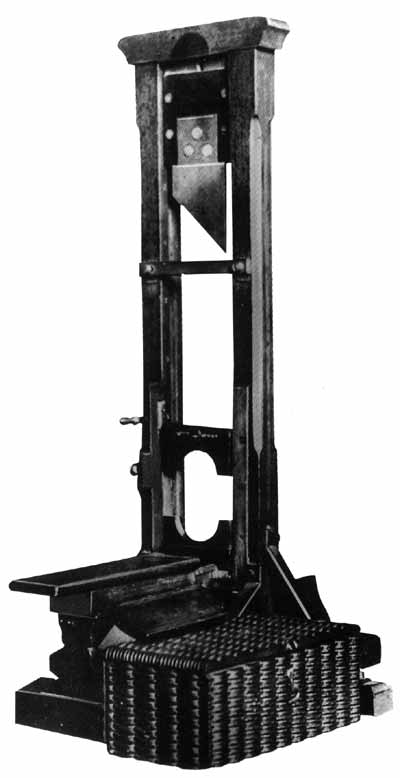
1. a device for beheading a person by means of a heavy blade that is dropped between two posts serving as guides: widely used during the French Revolution.

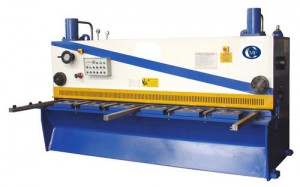
2. any of various machines in which a vertical blade between two parallel uprights descends to cut or trim metal, stacks of paper, etc.

Origin:
1785–95; named after J. I. Guillotin (1738–1814), French physician who urged its use

Disclaimer: C Marshall Fabrication Machinery in no way condones beheading, and in no way, shape or form should any of its offerings be interpreted for such or similar uses.

Although the guillotine should by no means be confused with the guillotine shears sold here at C Marshall Fabrication Machinery, their basic mechanical functions can both be traced to the same origins.

Many of us are familiar with the gorgeous irony of the Nobel Peace prize, which was established by the Swedish chemist Alfred Nobel – whose original claim to fame was his invention of dynamite.

However, although its story is just as ironic as that of the Nobel Peace Prize, the history and namesake of the original guillotine is not widely known.

Most commonly associated as a bloody icon of the horrors of the French Revolution, the guillotine was originally invented by Doctor Antoine Louis, the Secretary of the Academy of Surgery in France. Its purpose was to devise a machine that would basically kill people equally. More specifically, the dawn of the French Revolution also happened to coincide with the Age of Enlightenment, which was sweeping through not only France but all of Europe at the time. As part of the restructuring of the French government, it was reasoned that a standardized and swift method of execution should be made readily and uniformly available throughout France. Also in keeping with the “enlightenment” of the times was the desire for a less painful and less torturous form of execution.

Enter Dr. Joseph-Ignace Guillotin, a big fan of Voltaire and Locke, and a champion of “humanitarian” forms of execution.

Originally laughed out of France’s new Legislative Assembly for his peace-loving, hippie-dippy beliefs (the French still preferred lots of blood, guts and noisy screaming when it came to their justice procedures), Dr. Guillotin proposed that decapitation should become the sole method of execution in France. The machine he proposed for the job was a prototype of Dr. Antoine Louis’ handy-dandy decapitation machine, which even included a privacy screen for enhanced dignity of its soon-to-be headless customers. Guillotin’s proposal was, in fact, ahead of its time in that it advocated, for the first time in France’s history, a fast and painless method of execution that was egalitarian, regardless of background, social status, age, sex or rank: in short, it was seen as an embodiment of such enlightened concepts as humanity and equality.

If Death is the great Equalizer, then the guillotine was its first true enforcer.

In spite of his lofty ideals, once Guillotin’s proposal took hold in actual French law, his name became irrevocably associated with rolling heads, and thus the name “guillotine” was born. Dr. Guillotin’s children, who were none too thrilled by this association, respectfully requested that the French government change the name of the beheading machine. Although the government wouldn’t concede to their request, it did offer them the option of changing their own names – which they did, to distance themselves from the icon of execution that had become their namesake.

The fact that guillotine shears still to this day operate on the same basic principles as the original beheading machine is a testament to their functionality of design. In this sense, at least, the Age of Reason seems to have prevailed. After all, “if it ain’t broke, don’t fix it”; and as long as you read the instructions, you probably won’t lose your head using one.

-Anja Wulf

US Manufacturing News

US Manufacturing Remains Strong, Expert Writes.

In an article titled “The Truth About US Manufacturing,” Mark Perry, a professor of economics at the University of Michigan, Flint, and a visiting scholar at the American Enterprise Institute, writes in the Wall Street Journal (2/25, Perry, subscription required) that while some people may believe that manufacturing is on the decline in the US. But the data, Perry writes, shows that manufacturing remains strong in this country. Times are tough for many in the industry, Perry concedes. But he argues that with the proper skills, American workers will still have a place in the new US manufacturing economy.

Kansas City Regional Manufacturing Activity Index Hits Several Highs.

The Kansas City Business Journal (2/25, Dornbrook) reports, “Regional manufacturing activity hit several highs in February, and companies also expect strong activity in the months ahead, according to a survey by the Federal Reserve Bank of Kansas City.” The Kansas City Fed reported “the seasonally adjusted index, which can range from 100 to minus-100, came in at a high of 23,” up from 18 this time last year. “Other measurements also hit highs, with the index reflecting new order volume surging and the employment index swinging to a positive reading.”

SME Daily Executive Briefing, Febr. 25, 2011

Touch Command EVO

The Newest Evolution in CNC Technology

MG is very proud to introduce the Touch Command EVO – the latest version of their popular CNC system completely designed and flawlessly integrated with MG machines through years of research and development. The control retains its easy to use interface on the surface of previous controls that our customers have enjoyed; however, underneath it there is an all new extremely powerful engine which delivers a precision of control never before found on a plate rolling machine. This is mainly achieved by the new closed loop system which constantly monitors the rotation and side roll positions.

There are some unique challenges when it comes to designing a true CNC control for a plate rolling machine. The main challenge is the difference in yield tolerances of the material being rolled.

Let’s look at A516 gr70 which is one of the most common types of steel plate used today. It has a minimum yield rating of 38,000 psi; however, it’s possible for the yield to be higher than the minimum rating, let’s say 45,000 psi for this example:

Company A is receiving material that is 38,000 psi from a supplier in the Northwest  and company B is receiving material from a different supplier in the Midwest that is 45,000 psi. If these two plates are rolled on the same machine using the same settings they will roll to different diameters due to the different yields even though they are both A516 gr70 plates. There is not a CNC control available that can take these differences into account and automatically adjust for them without some operator intervention.

MG has taken the unique approach of designing a material library that can be adjusted to work specifically with the material you are receiving. This is done by making 3 test bends with your specific material and inputting the diameters that were actually achieved. Once this is done and the computer understands how your material reacts or springs back, it can accurately auto-generate programs of virtually any shape required with the material you adjusted the library for – round, square, triangle, elliptical, etc.

If you do happen to buy material that has a slightly different yield than normally you can use the powerful corrections page which gives you the ability to adjust any section of the part you are rolling independently. The transitions on parts with more than one diameter are flawless due to the all new closed loop system that was designed to check for the correct side roll position every 0.039 inches of rotation. If the side rolls starts to deviate from the correct position during a transition the rotation will speed up or slow down automatically to ensure the transition is correct. This is crucial when rolling parts with changing diameters.

There is also a completely new CAD system included which allows you to draw shapes to be rolled right on the control or if you prefer you can upload a DXF file. After your shape is loaded just choose your material and the computer will generate a program to roll your part. The number of steps in a program along with how many programs can be stored are virtually unlimited. The touch screen is easy to navigate and can be used while wearing gloves. Programs can be backed up via USB keys for easy offline storage.

The CNC Touch Command EVO is the most user friendly and accurate rolling sytem ever produced for a plate roll. Thanks to the above-described closed loop system the material waste has been virtually eliminated.

Technical Characteristics:

  • Amount of saved programs is virtually unlimited
  • Amount of steps per program is virtually unlimited
  • Linux operating system
  • New generation mother board conforms to Rohs regulations
  • Integrated graphical card with accelerated 3D hardware
  • Intel Celeron Mobile 1.5 GHz CPU with lower operating temperature (optimal for industrial environments)
  • Memory DIMM type DDR 1 GHz
  • The direct connection of the LVDS display leaves the VGA port open for connecting an external monitor
  • The touch screen display conforms to Rohs regulations
  • Calculation Capacity has tripled compared to previous versions
  • Front panel with more input/output ports: 2 USB, 1 Serial, 1 Ethernet

When choosing a 4 roll machine with a CNC control there really is no better choice than the Touch Command EVO.

By Brian Hill, MG

Touch Command EVO

The Newest Evolution in CNC Technology

MG is very proud to introduce the Touch Command EVO – the latest version of their popular CNC system completely designed and flawlessly integrated with MG machines through years of research and development. The control retains its easy to use interface on the surface of previous controls that our customers have enjoyed; however, underneath it there is an all new extremely powerful engine which delivers a precision of control never before found on a plate rolling machine. This is mainly achieved by the new closed loop system which constantly monitors the rotation and side roll positions.

There are some unique challenges when it comes to designing a true CNC control for a plate rolling machine. The main challenge is the difference in yield tolerances of the material being rolled.

Let’s look at A516 gr70 which is one of the most common types of steel plate used today. It has a minimum yield rating of 38,000 psi; however, it’s possible for the yield to be higher than the minimum rating, let’s say 45,000 psi for this example:

Company A is receiving material that is 38,000 psi from a supplier in the Northwest  and company B is receiving material from a different supplier in the Midwest that is 45,000 psi. If these two plates are rolled on the same machine using the same settings they will roll to different diameters due to the different yields even though they are both A516 gr70 plates. There is not a CNC control available that can take these differences into account and automatically adjust for them without some operator intervention.

MG has taken the unique approach of designing a material library that can be adjusted to work specifically with the material you are receiving. This is done by making 3 test bends with your specific material and inputting the diameters that were actually achieved. Once this is done and the computer understands how your material reacts or springs back, it can accurately auto-generate programs of virtually any shape required with the material you adjusted the library for – round, square, triangle, elliptical, etc.

If you do happen to buy material that has a slightly different yield than normally you can use the powerful corrections page which gives you the ability to adjust any section of the part you are rolling independently. The transitions on parts with more than one diameter are flawless due to the all new closed loop system that was designed to check for the correct side roll position every 0.039 inches of rotation. If the side rolls starts to deviate from the correct position during a transition the rotation will speed up or slow down automatically to ensure the transition is correct. This is crucial when rolling parts with changing diameters.

There is also a completely new CAD system included which allows you to draw shapes to be rolled right on the control or if you prefer you can upload a DXF file. After your shape is loaded just choose your material and the computer will generate a program to roll your part. The number of steps in a program along with how many programs can be stored are virtually unlimited. The touch screen is easy to navigate and can be used while wearing gloves. Programs can be backed up via USB keys for easy offline storage.

The CNC Touch Command EVO is the most user friendly and accurate rolling sytem ever produced for a plate roll. Thanks to the above-described closed loop system the material waste has been virtually eliminated.

Technical Characteristics:

  • Amount of saved programs is virtually unlimited
  • Amount of steps per program is virtually unlimited
  • Linux operating system
  • New generation mother board conforms to Rohs regulations
  • Integrated graphical card with accelerated 3D hardware
  • Intel Celeron Mobile 1.5 GHz CPU with lower operating temperature (optimal for industrial environments)
  • Memory DIMM type DDR 1 GHz
  • The direct connection of the LVDS display leaves the VGA port open for connecting an external monitor
  • The touch screen display conforms to Rohs regulations
  • Calculation Capacity has tripled compared to previous versions
  • Front panel with more input/output ports: 2 USB, 1 Serial, 1 Ethernet

When choosing a 4 roll machine with a CNC control there really is no better choice than the Touch Command EVO.


Small and midsize businesses sensing better times ahead

More Businesses Seeking Loans, Making Acquisitions.

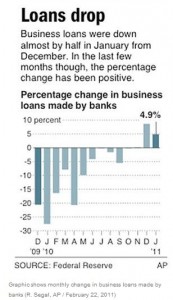
In the last three months of 2010, U.S. Bancorp wrote $8 billion in new business loans, the most in two years. JPMorgan Chase added 400 midsize companies as clients. And bank loans overall grew for the first time in two years, according to the Federal Reserve.

“Companies are talking about growth in ways they haven’t for three years,” says Perry Pelos, head of Wells Fargo’s commercial banking.

Loans are one of the best gauges of economic growth. Small and midsize businesses that form the backbone of the U.S. economy take them out to pay for business needs — unlike big corporations, which go to the bond markets for low-cost debt.

Borrowing by smaller companies is being watched especially closely because it may indicate those companies are preparing to hire. So far, the economic recovery hasn’t been accompanied by job growth. Small companies created about three of every five new jobs over the past two decades.

Those companies took a pummeling during the recession. Bankruptcies skyrocketed and led to massive job cuts. Firms employing fewer than nine people accounted for more than half the jobs lost in the first quarter of 2010, just after the recession technically ended, according to the Labor Department.

Many small businesses blame banks for making matters worse by pulling back credit dramatically after the financial crisis.

Vu Thai, president of Efficient Lighting of Buena Park, Calif., wanted more space to house his energy-efficient light bulbs and fixtures at the end of 2008. “Nobody would lend to us,” Thai says.

But demand for Thai’s bulbs increased, and he snagged Home Depot as a customer last year, sending sales up 10 percent. In December, Thai secured a $100,000 loan to install racks and other equipment in his new warehouse. He bought the space with another loan of $1.6 million taken jointly from Bank of America and a government program for small businesses.

In another hopeful sign, about 75 percent of the loans taken out in the last three months were to pay for mergers and acquisitions. That shows that companies that can afford it are buying up weaker competitors as they prepare for growth in the months ahead.

“After surviving a brutal recession, companies are starting to look around them for opportunities to get stronger,” says Laura Whitley, an executive at Bank of America’s global commercial banking business.

Excerpt from article written by PALLAVI GOGOI AP Business Writer
7:04 a.m. CST, February 22, 2011

Click HERE for full article.

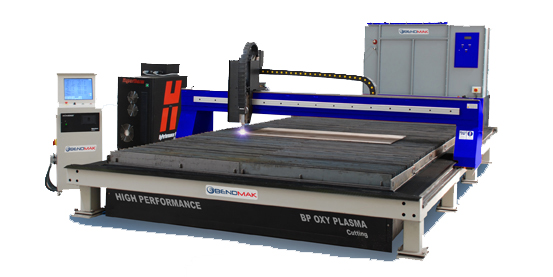
Plasma Burning Machine

Cutting with profit. Less scrap, more automation, higher performance.

Standard Features

  • Solid steel construction designed for high speeds
  • Fume extraction table with pneumatic switch control, exchangeable grills, dross collecting system which allows clean, safety and healthy working environment by vacuuming dust and fume which raises during plasma cutting process
  • High precise positioning possibility with linear sledge system in all axis
  • Synchronized drive allows a smoothly and vibration free motion
  • Brushless AC servo motors  ( on all axis)
  • Pinion and gear rack drive system facilitates smooth and fast motion
  • Up to  +.004” precise positioning
  • Automatic height control and automatic ignition torch system
  • Torch collision protection
  • Windows based CNC control unit
  • Vestige plate stock management database with optional auto-nesting program which provides economy on material and saves time
  • In comparison to laser cutting, plasma cutting decreases the cost of the process by 20%. With similar cutting quality, plasma is a preferable alternate to laser cutting.
  • Cutting surface is close to 90 degrees and the vertical roughness tolerance is in minimum level.
  • Manual

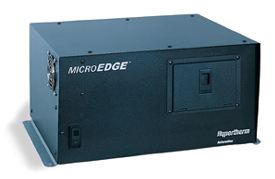
HYPERTHERM EDGE UNIT (USA)

  • Graphical user interface, easy and flexible use with SOFTMOTION technology
  • Windows based industrial PC
  • Touch screen display
  • Strong and reliable processor
  • 15” LCD Monitor (touchscreen)
  • Standard  PC power supply
  • Automatic and manual control during oxy-cutting process
  • USB, CD, floppy disc input to load the shapes
  • Cutting processes are can be followed from the screen

HYPERTHERM 130

  • Cutting mild steel from .020” to 1.5”
  • Prevents dross by cutting, so no second cutting process required
  • Easy, fast and correct gas usage through optional auto gas control.
  • Saves cost by high definition cutting quality.
  • Depending on material no or only little dross formation
  • Durable torch consumables
  • Minimum gas and energy loss through high definition plasma arc technology
  • Repeatable cutting quality
  • Perfect cutting quality of Hy-performance on stainless steel
  • Durable consumables
  • Hy-performance plasma control is user friendly.
  • Changing of the torch very easy and fast
  • Bevel cutting possibility up to 45 degrees.
  • Marking is also achievable with the same torch. With the continuously
    current gauge the cutting performance could be repeated up to 1-9/16”.

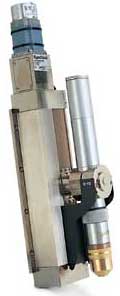
HYPERTHERM Command THC

Height control

  • Torch height control can be adjusted easily by arc voltage feedback control which affects the cutting quality positively.
  • Collision avoidance system is designed mechanically and electronically.
  • Torch height control system through microprocessor.
  • All values and also errors could be found easily through the relaying indicators.
  • Optional breakdown is designed in order to reduce or eliminate damage to the torch due to accidental collisions in all axis.
  • System control can be reviewed or can be transferred to the CNC control.

Factory Activity Grows; Utilities Dip After Storms

by The Associated Press
February 16, 2011

Factories produced more goods for the fifth straight month in January as strong auto sales spurred demand for new cars and trucks. But overall U.S. industrial production fell for the first time in 19 months.

Output by America’s factories, mines and utilities dipped 0.1 percent last month, the Federal Reserve said Wednesday. The decline was caused mostly by a decrease in output by utilities after a weather-related peak in December.

Industrial production increased in every month but one last year. It has risen by more than 11 percent since hitting its recession low in June 2009. But it remains about 6 percent below its pre-recession peak in 2007.

Manufacturers boosted their output last month by 0.3 percent, led by increased production of autos and business equipment. Output of consumer goods edged up modestly.

“Despite a small decline in overall industrial production, solid growth in the manufacturing sector continues to lead the recovery,” said Thomas Duesterberg, president and CEO of the Manufacturers Alliance/MAPI, an industry group.

Duesterberg said the group expects demand for exports, business equipment and long-lasting consumer goods such as autos to boost factory output by at least 5.5 percent this year. That’s the same amount it increased in the past 12 months.

“If relative weakness in the aerospace sector and in construction materials and supplies for the U. S. market were to turn around, we could see even stronger growth in 2011 and 2012,” Duesterberg said.

The increase in factory output was expected, in part because factories added 49,000 jobs last month, the most since August 1998. And factory employees worked longer hours, another positive sign for output.

Severe winter storms in January might have limited some factories’ ability to increase production.

Overall production increased in December by the largest amount in seven months. The Fed revised December’s production gains upward to 1.2 percent from 0.8 percent.

U.S. industry operated at 76.1 percent of its total capacity in January, a decline of 0.1 percent from December, the Fed said.

Manufacturing is the single largest component of industrial production. Output by utilities decreased by 1.6 percent in January. Mines produced 0.7 percent less.

Sales of cars and light trucks in January rose 17 percent from a year earlier, as Americans signaled that they were ready to replace their clunkers. Nearly all big car companies reported double-digit gains for the month, a sign that the slow recovery in U.S. auto sales that began in 2010 remains on track.

Sales of auto parts also have boomed, as some consumers choose to drive their cars longer.

Brisk demand helped auto makers produce 3 percent more cars and parts in January than they did in December, the Fed said.

What if?

Today I was looking at the C Marshall Fabrication Machinery Shears, and, as most of you who have been reading my post will know, that can lead to very odd places.

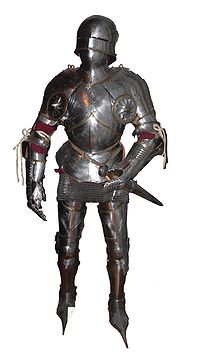
Once upon a time, in land far far away – ancient Greece and Rome to be exact, plate armor was invented and put into use.

Now, like most people, when I think of plate armor I think of Camelot, the Round Table, the Knights, etc., but interestingly enough, it was the Greeks, then the Romans who were the first “knights”.

The first plate armor was made of Bronze, but was only worn by elite soldiers as it was expensive as bronze is a combo of copper and tin. Today, most of us could tip up the cushions on our couch and find enough pennies to plate an army, but back then copper wasn’t as readily available.

So, as with everything, cost drove the Greeks and Romans to abandon it, particularly after the fall of the Roman Empire.

I mean really, if your empire is already fallen what do you need armor for right?

Of course things picked up in the 14th century and plate armor once again had a place in the world, especially with steel being used as the primary material.

However, it was still costly and time consuming to make, and only the upper strata could afford to buy it. Then of course you had to be strong enough to wear the stuff.

That’s where the knights came in. The knights, being nobility (and having to prove it with patents of nobility), were the only ones who could afford such a luxury.

Then the musket came. Thus marked the beginning of the end for plate armor…well the armor we’re talking about anyway.

The steel used for plate armor was great for swords and arrows, but just a smart man doesn’t bring a knife to a gun fight, he doesn’t pretend that his plate armor is going to stop a bullet either.

Now to my wrap up. I like stories and notions of alternative history. I like the ‘what if’ factor in them.

Many writers who write such, often focus on ‘what if a tank went back in time’ or ‘what if an airplane went back in time’. I like to think outside the box a bit, as those of you who know me can attest to.

What if an entire line of C Marshall Fabrication Machinery products were dropped into Germany in 1632 in the middle of the Thirty Years War? Mind you this is a war that completely devastated what is now Germany and in my opinion set the tone thereafter for the German people. As a people, they were never going to let that happen again. And that mind set eventually led too…well you know the rest there.

Think about it. What if they were given the tools to completely arm every soldier regardless of income or status? It could have given them the edge and victory instead of devastation. That victory could have then changed their mindset completely, therefore affecting the rest of history in so many ways.

I will let you mull that over, but a few words come to mind. Hitler, Holocaust, WWII.

What if?

U.S. manufacturers see emerging market boost

Reuters
1:04 p.m. CST, February 8, 2011

BOSTON (Reuters) – Strong demand from big emerging markets, particularly China and India, is boosting U.S. manufacturers’ prospects for 2011, a pair of top executives said on Tuesday.

But not everyone in the sector regards the recovery from the worst recession the world has seen in living memory as a sure thing.

“We feel very good about the economy,” said Greg Hayes, chief financial officer at United Technologies Corp . “There’s good news, but we’re not out of the woods yet … It’s going to be a gradual, slow, uneven recovery.”

A top General Electric Co executive sounded a more confident note on the economy in a presentation to investors.

“We feel really good about emerging market demand, really across all of our infrastructure businesses,” said John Rice, a GE vice chairman who oversees the company’s international operations. “We’re starting to see some signs that the economy is rebounding a little bit.”

Rice, recently transferred to Hong Kong and charged with accelerating GE’s growth outside the United States, said the company is changing the way it approaches developing markets. Building on a recent successful test in India, the largest U.S. conglomerate plans to move more higher-ranking executives into emerging markets to speed its decision-making, rather than requiring local executives to consult with headquarters in Fairfield, Connecticut.

The company has also begun designing more equipment, such as medical devices, with emerging-market customers in mind, rather than trying to retool machines made for rich customers.

“You can’t do it by downsizing … what you have,” Rice said. “You have to start with a clean piece of paper.”

Hartford, Connecticut-based United Tech is counting on growth in emerging markets — where it generated more than 20 percent of its revenues for the first time in its history last year — to drive 2011 sales growth, Hayes said.

The world’s largest maker of air conditioners and elevators expects to grow its Indian revenue to $2.5 billion by 2015, up from $500 million last year, Hayes told the same investor conference.

(Reporting by Scott Malone, editing by Gerald E. McCormick)

In Business Outreach, Obama Urges Companies To “Invest In America.”

To mostly positive media reviews, President Obama yesterday addressed executives in what has been billed by the White House as major outreach from Washington to business. His speech received widespread coverage in most major media outlets, some of which also reported on the reaction by business.

ABC World News (2/7, lead story, 2:50, Sawyer) reported that the President “delivered an urgent message to the companies to get in the game, start spending money and hiring workers — throwing down a gauntlet but also trying to build a bridge.” ABC (Tapper) added that “Obama is desperate to get the economy going,” and showed him saying, “So if I’ve got one message, my message is now is the time to invest in America. Now is the time to invest in America. And if there is a reason that you don’t share my confidence, if there is a reason that you don’t believe that this is the time to get off the sidelines, to hire and to invest, I want to know about it. I want to fix it.”

The CBS Evening News (12/7, story 3, 2:25, Couric) said “Obama continued his campaign to improve relations with business,” urging “corporate America to invest the nearly $2 trillion it has saved up and start hiring again. For his part, he President promised to address their complaints about the corporate tax code and burdensome government regulations.”

Bloomberg News (2/8, Brower, Dorning) reports that in his remarks, “Obama said he is doing his part to improve the business climate after a free- trade agreement with South Korea, a deal to extend Bush-era tax cuts, and a State of the Union address that proposed more government support for infrastructure and ‘innovation.'” The President “touched on some of the same themes he struck in his State of the Union address: the need to rebuild and modernize the nation’s transportation and telecommunications systems and take steps that will promote research and innovation in areas such as biotechnology, information technology and clean energy.”

Politico (2/8, Cummings),The Wall Street Journal (2/8, Williamson; subscription required), Financial Times (2/8, Braithwaite; subscription required) and Christian Science Monitor (2/8, Feldmann), among other news outlets, also report on Obama’s speech.

SME Daily Executive Briefing
2/8/2011